
Research
Our group focuses on the development of new methods and strategies for discovering biologically-active small molecules. We then apply these new approaches to discover tools that can be used to interrogate biological mechanisms. Current strongly developed research themes are:
1. High-throughput bioactive molecular discovery
2. Application of chemical probes to elucidate biological and biomedical mechanisms
We also harness a chemical biology approach to elucidate a wide range of biological mechanisms, generally in collaboration with biomedical scientists at Leeds and elsewhere. Here, we exploit chemical tools that have been discovered using our distinctive molecular discovery approaches. A key recent development has been the establishment of a chemical proteomics platform at Leeds which can enable both target identification and validation.
High-throughput bioactive molecular discovery
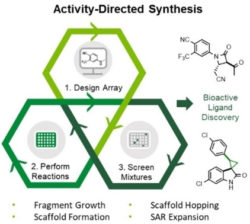
We have pioneered high-throughput approaches for the discovery of bioactive molecular discovery that, for example, integrate algorithms, plate-based chemistry, automation and biological assays. Examples of our approaches include:
- Activity-directed synthesis, a function-driven and structure-blind molecular discovery approach which is broadly analogous to the evolution of biosynthetic pathways to natural products, a process that is driven by functional benefit to the host organism.
- Algorithm-driven, activity-directed "closed loop" approaches in which all reaction arrays are algorithmically-designed and robotically executed
- Operationally-simple, "direct-to-biology" approaches which democratise the high-throughput discovery and optimisation of bioactive small molecules
Example publications:
- “Efficient discovery of bioactive scaffolds by activity-directed synthesis”, G. Karageorgis, S. Warriner and A. Nelson, Nature Chem. 2014, 6, 872-876. Paper
- “Algorithm-Driven, Phenotype-Directed Bioactive Molecular Discovery”, A.-S. Piticari, S. D. Griggs, L. Crawford, J. Whittle, B. S. Mantilla, S. Sievers, M. H. Wright, S. P. Marsden, M. Basham and A. Nelson,* Research Square 2025, DOI: 10.21203/rs.3.rs-8058819. Paper
- “High-throughput discovery and characterisation of pentafluorobenzene sulfonamide modifiers of Aurora A kinase”, J. Chesti, J. A. Miles, L. J. Collins, H. A. McCallum, M. Foglizzo, M. S. Ahangar, E. Zeqiraj, R. Bayliss, S. L. Warriner, M. H. Wright and Adam Nelson*, RSC Chemical Biology 2026, DOI: 10.1039/D5CB00290G. Paper
- “Algorithm-driven activity-directed expansion of a series of antibacterial quinazolinones”, D. Francis, S. Farooque, A. Meager, D. Dirks, A. Leggott, S. Warriner, A. J. O’Neill and A. Nelson, Org. Biomol. Chem. 2022, 20, 9672-9678. Paper
- “Activity-directed synthesis: A flexible approach for lead generation”, G. Karageorgis, S. Liver and A. Nelson,* ChemMedChem 2020, 15, 1776-1782. Paper
- “Streamlining bioactive molecular discovery through integration and automation”S. Chow, S. Liver and A. Nelson, , Nat. Rev. Chem. 2018, 2, 174-183. Paper
Application of chemical probes to elucidate biological and biomedical mechanisms

We work highly collaboratively to apply our novel chemical probes to elucidate biological and biomedical mechanisms. We often use a chemical proteomic approach to enable determination of the cellular targets of our probes. We have recently worked across many areas, for example trypanosome biology (T. brucei), stem cell biology, and bacteriology (Chlamydia). Currently, we are focusing on molecular mechanisms involving protein kinases (with Richard Bayliss and Megan Wright) and deubiquitinases (with Elton Zeqiraj).
Example publications:
- “Discovery of Trypanosoma brucei inhibitors enabled by a unified synthesis of diverse sulfonyl fluorides”, B. S. Mantilla, J. S. White, W. R. T. Mosedale, A. Gomm, A. Nelson,* T. K. Smith* and M. H. Wright*, Commun. Chem. 2024, 7, 237. Paper
- “Identification of Dihydroorotate Dehydrogenase Inhibitors using the Cell Painting Assay”, B. Schölermann, J. Bonowski, M. Grigalunas, A. Burhop, Y. Xie, J. G. F. Hoock, J. Liu, M. Dow, A. Nelson, C. Nowak, A. Pahl, S. Sievers and S. Ziegler, ChemBioChem 2022, 23, e202200475. Paper
- “Morphological Subprofile Analysis for Bioactivity Annotation of Small Molecules”, A. Pahl, B. Schölermann, M. Rusch, M. Dow, C. Hedberg, A. Nelson, S. Sievers, H. Waldmann and S. Ziegler, Cell Chem. Biol. 2023, 30, 839-853.E7 Paper
- “Involvement of glycogen synthase kinase-3 in regulation of murine embryonic stem cell self-renewal revealed by a series of bisindolylmaleimides”, H. K. Bone, T. Damiano, S. Bartlett, A. Perry, J. Letchford, A. Nelson and M. J. Welham Chem. Biol. 2009, 16, 15-27. Paper